RWA Market Pulse:
Why Knowing What Actually Changed Matters
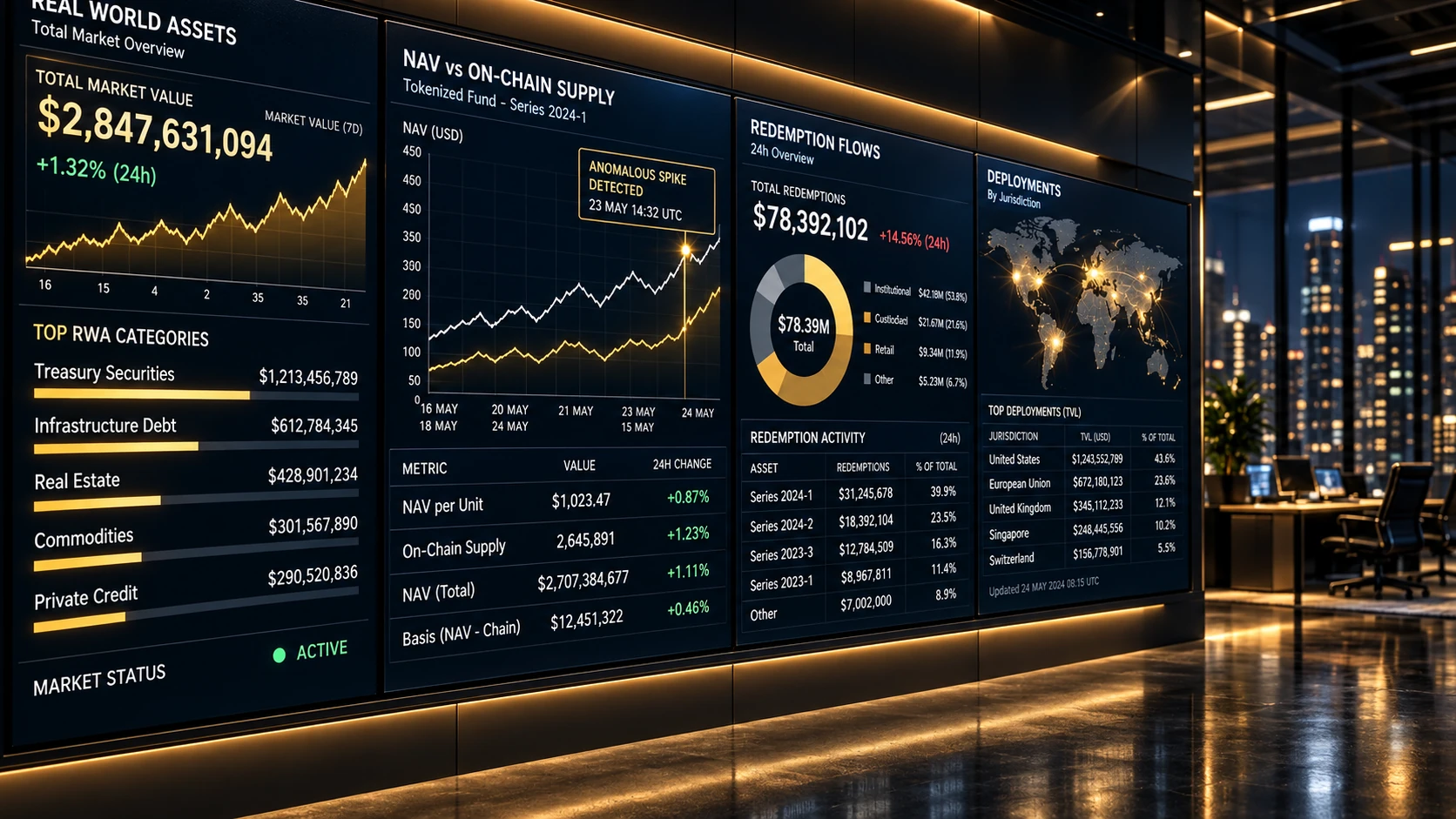
Tokenized real-world asset markets generate a constant stream of numbers. The difficult question is not whether something changed. It is: what materially changed—and does it actually matter?
Supply changes. TVL moves. New contracts appear. Issuers announce deployments. Products migrate between blockchains. Market values rise and fall. Headlines describe billions of dollars moving into tokenization.
A Market Pulse establishes the baseline facts needed to separate ordinary market noise from developments that deserve deeper investigation.
The Problem With Watching RWA Markets From a Dashboard
Dashboards are useful. They can show market size, product values, blockchain deployments, token supply, and changes over time. But the number on the screen is only the beginning of the investigation.
Suppose a tokenized Treasury product suddenly shows a 12% decline in reported value. It is tempting to conclude that investors pulled 12% of their money. Several different events could produce a similar surface signal:
- · an actual redemption;
- · a token burn;
- · a contract migration;
- · a source or classification change;
- · a revised historical value;
- · an asset-price or NAV movement;
- · a change in the products included in the dataset;
- · or a genuine movement of capital.
Those explanations are economically very different.
“A dashboard may show what moved. A Market Pulse asks what actually happened.”
What Is an RWA Market Pulse?
An RWA Market Pulse is a structured market-intelligence framework designed to answer one primary question: What materially changed since the previous evidence cutoff?
The objective is not to summarize every number that moved. It is to identify changes significant enough to deserve attention and determine what the available evidence actually supports.
The framework examines three broad areas:
-
⯈
Surface anomalies. Unexpected changes in reported market values, supply, activity, rankings, or other observable metrics.
-
⯈
Contract and infrastructure changes. New deployments, migrations, token contracts, minting authorities, blockchain expansions, or changes to the infrastructure supporting an asset.
-
⯈
Baseline structural shifts. Developments that may indicate a meaningful change in market composition, product position, issuer activity, or the structure of a sector.
The result is a cleaner picture of the market before deeper analysis begins.
Why This Matters
RWA markets combine traditional financial infrastructure with blockchain infrastructure. That makes interpretation harder than simply watching a cryptocurrency price chart.
- · A token can exist on-chain while the underlying asset is held by a custodian.
- · Subscriptions and redemptions may occur through regulated entities.
- · NAV calculations can operate on a different schedule from blockchain activity.
- · Products may expand onto additional networks without representing new capital.
- · Token balances can change for operational reasons that have little to do with investor demand.
A visible market change does not automatically explain its own cause. The Market Pulse creates a disciplined starting point.
Instead of asking "What story can we tell about this number?", the better question is "What does the evidence allow us to say changed?" That distinction is fundamental to institutional research.
How Market Pulse Works
Signal vs. Surface
This is why the Market Pulse is useful. It does not eliminate uncertainty. It identifies the uncertainty correctly.
| Surface signal | Easy conclusion | Market Pulse question |
|---|---|---|
| Supply rises sharply | New investor demand | Was it a subscription, distribution, migration, or administrative issuance? |
| Reported value falls | Investors exited | Was there a redemption, NAV movement, reclassification, or source revision? |
| Product moves up rankings | Product gained market share | Did the product grow, did competitors shrink, or did the comparison universe change? |
| New blockchain deployment appears | Adoption increased | Is meaningful supply actually deployed there? |
| Transfer activity spikes | Usage exploded | Was it genuine user activity, internal movement, market making, or contract migration? |
A Starting Point for Deeper Investigation
The Market Pulse is not intended to answer every possible question about an asset. Its job is to determine where deeper research is justified. A material change identified by the Market Pulse might lead to questions such as:
- · Is capital rotating between tokenized Treasury products?
- · Did an issuer materially change its product structure?
- · Did a new blockchain deployment alter accessibility or risk?
- · Was a supply decline caused by redemptions?
- · Did custody or backing arrangements change?
- · Did a regulatory filing alter how the product operates?
- · Is an apparent market disruption actually a data problem?
Those questions belong to deeper forms of due diligence. The Market Pulse helps determine which ones are worth asking. In that sense, it acts as the first inspection layer of an RWA intelligence system.
Why Evidence Cutoffs Matter
A credible Market Pulse also needs a fixed evidence cutoff. Without one, research can quietly mix observations from different moments and create a story that could not actually have been known at the time.
For example, a value reported on Monday might later be revised on Wednesday. That does not necessarily mean the Monday observation was fabricated or useless. It means the research record should distinguish:
- · what the source reported at the original cutoff;
- · what the source reported later;
- · and whether the later information represents a new observation or an actual correction.
That creates an auditable timeline instead of rewriting history every time a dataset changes. For institutional research, that distinction matters.
Who Is This Useful For?
The value is not simply receiving more data. It is knowing which changes deserve attention.
Issuers & tokenization platforms
Track meaningful competitive changes without relying solely on headline market rankings.
Treasury & allocation teams
Identify products or sectors that deserve deeper diligence before committing resources to a full review.
Risk & collateral teams
Spot changes in market structure, concentration, supply, or product mechanics that may warrant investigation.
Investment & research teams
Establish a documented market baseline before analyzing a product, issuer, or sector.
Infrastructure providers
Chains, custodians, and service providers can better understand where deployment and product activity are actually changing.
What a Good Market Pulse Should Not Do
A disciplined Market Pulse should also know what it cannot conclude.
- · A change in reported value does not automatically prove a capital flow.
- · A supply increase does not automatically prove new investor demand.
- · A transfer spike does not automatically prove adoption.
- · A new deployment does not automatically prove meaningful usage.
- · A later source value does not automatically invalidate an earlier frozen observation.
- · Two events happening near each other in time do not automatically establish causation.
When the evidence does not resolve the explanation, the correct output is not a confident story. It is a clearly defined research question.
From Market Noise to Research Priority
The tokenized asset market will continue producing more products, more blockchains, more data feeds, and more metrics. More data does not automatically produce better intelligence.
The advantage comes from determining:
- · What changed?
- · What does the evidence actually prove?
- · What does it not prove?
- · And what deserves investigation next?
That is the role of the RWA Market Pulse. It turns a stream of changing numbers into a disciplined research starting point—separating surface movement from developments that may actually matter.
For institutional RWA diligence, that distinction can be the difference between reacting to a dashboard and understanding the market underneath it.